
Microchip Pet Doors for Rabbits and Ferrets
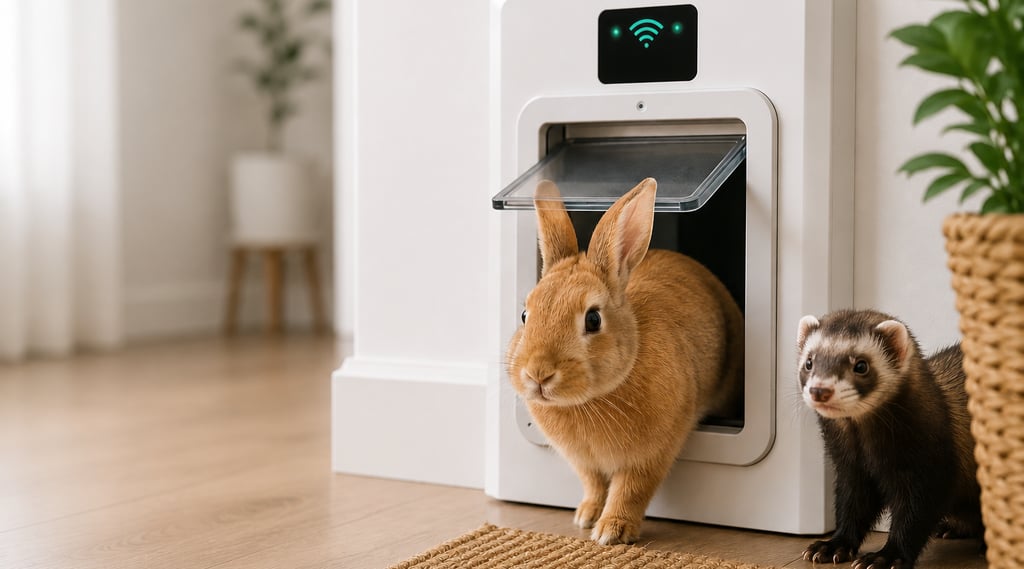
Microchip pet doors for rabbits and ferrets roam freely while keeping dogs and cats locked out. Here's how the technology works, how to install it, and which setups work best.
SMALL ANIMAL
Christina Pawlowski Pet Ecosystems Team
5/22/20269 min read
Microchip Pet Doors for Rabbits and Ferrets: Safe Free-Roam in Multi-Pet Homes (2026)
Rabbits and ferrets are two of the most cognitively active small pets you can keep — and two of the most poorly served by standard cage living. Both species need daily out-of-cage time to maintain physical health and behavioral stability. Both are also at real physical risk in households with dogs and cats, where a single unsupervised chase event can be fatal.
A microchip-activated pet door solves this problem directly: the small pet can move freely between rooms through a door that physically locks out every other animal in the house. No supervision required. No temporary barriers that determined dogs knock over. No choosing between keeping the rabbit confined all day or watching it nervously every time the dog enters the room.
This guide explains how these systems work, how to set them up specifically for rabbits and ferrets, and what the real-world experience looks like in a multi-pet household.
Why Rabbits and Ferrets Need More Than a Cage
The perception of rabbits as low-maintenance cage animals has shifted significantly over the past decade as more owners have observed what actually happens when small mammals get adequate space and enrichment.
Rabbits are prey animals with strong territorial and exploratory instincts. In the wild, European rabbits (the ancestor of all domestic breeds) maintain home ranges of 0.4–2 hectares and spend several hours daily foraging, exploring, and maintaining social hierarchies. Domestic rabbits confined to a cage for 20+ hours a day frequently develop:
GI stasis — reduced gut motility linked to inactivity and stress, a potentially life-threatening condition
Spondylosis — spinal deterioration from insufficient movement, common in middle-aged rabbits kept in small enclosures
Stereotypic behaviors — repetitive cage bar chewing, circling, and head pressing that indicate chronic boredom and stress
Obesity — sedentary rabbits on pellet-heavy diets are significantly more prone to weight-related health issues
Ferrets are obligate carnivores descended from European polecats, with high metabolic rates and strong play and hunting drive. Ferrets kept in cages without adequate daily out-time (minimum 4 hours recommended by most exotic vets) show elevated cortisol levels, develop adrenal disease at higher rates, and display the frantic "war dance" behavior almost exclusively when finally released — a visible indicator of pent-up energy.
The solution — supervised free-roam access to part of the home — is well established in the exotic pet community. The complication is managing that access safely in mixed-species households.
The Problem with Standard Separation Methods
Most multi-pet households attempting to give small animals free-roam time rely on one of three approaches, all with significant failure modes:
Baby gates and exercise pens: Dogs can jump, knock over, or paw under lightweight plastic gates. Cats can climb over virtually any gate. Even a dog that respects the barrier creates stress for the small pet on the other side — the visual and olfactory presence of a predator-class animal is a constant stressor even without physical contact.
Scheduled rotation: Putting the dog in one room while the rabbit runs, then switching. This works but requires continuous owner presence, creates scheduling constraints, and still exposes the small animal to stress from hearing and smelling the larger animal through a door.
Constant supervision: Relies entirely on owner vigilance. Most injuries happen during brief moments of distraction — checking a phone, answering a door. For prey animals whose escape response is hardwired, a single chase sequence lasting seconds can cause fatal spinal injury from jumping or twisting.
Microchip pet doors remove the human variable from all three of these scenarios.
How Microchip Pet Doors Work
A microchip-activated pet door is an electronic flap or panel with a built-in RFID scanner in the frame. When an approved pet approaches, the scanner reads its implanted microchip ID, the electronic locking mechanism disengages, and the door opens. When the pet passes through, the lock re-engages immediately.
The system is passive from the pet's perspective — the door simply opens when they approach it, exactly as they'd learn to use any pet door. The "intelligence" is entirely in the lock-out mechanism: animals whose chip IDs are not registered in the door's memory cannot open it.
Key components:
ComponentFunctionRFID scanner (in door frame)Reads the pet's implanted microchip at close rangeElectronic lockEngages/disengages based on chip recognitionDoor panelFlap, sliding panel, or hinged door depending on modelProgramming interfaceRegisters approved chip IDs (typically tap-to-register)Power supplyBattery or mains; most current models run 6–12 months on AA batteries
Microchip compatibility: Most modern microchip pet doors read ISO 11784/11785 standard chips (the global standard used since the late 1990s), covering virtually all veterinary-implanted chips. Some models also read older FDX-A format chips. Verify your pet's chip standard with your vet before purchasing — chip reading failure is the most common installation issue.
What about pets without microchips? Rabbits and ferrets are not universally microchipped in the way dogs and cats are in many countries, but vet microchipping for small mammals is straightforward, inexpensive ($15–$40), and requires only a brief office visit. Some models also offer RFID collar tags as an alternative to implanted chips for animals where microchipping isn't appropriate.
The Free-Roam Safety Loop: Setting Up the System
The most effective multi-pet microchip door setup creates what rabbit and ferret owners commonly call a free-roam safety loop — a dedicated protected space connected to the main living area by a controlled access point.
The Safe Room
The foundation of the system is a dedicated room — a home office, spare bedroom, or converted utility room — that is fully proofed for the small pet and inaccessible to dogs and cats except through the microchip door:
For rabbits:
Remove or protect all electrical cables (rabbits chew wire instinctively)
Block access behind and under furniture where rabbits can become trapped
Provide hay, fresh water, a litter box, and enrichment toys
Cover or remove houseplants (many are toxic to rabbits)
Ensure flooring has grip — bare hardwood causes joint problems over time
For ferrets:
Block all gaps, holes, and spaces behind appliances (ferrets fit through any opening larger than their skull)
Remove rubber items, foam, and sponge materials (ferrets ingest these readily and cause GI blockages)
Provide a sleep hammock, tunnels, and dig boxes
Ensure the room is escape-proof at ceiling level — ferrets climb well
The Microchip Access Point
The door connects the safe room to the main living area. Installation options:
Interior door: The most common installation. A cat-flap-sized microchip door is cut into the lower panel of an interior door or installed in a purchased door insert. The SureFlap Microchip Pet Door and PetSafe Microchip Pet Door are the most widely used models for this application.
Baseboard tunnel: A growing trend in the exotic pet community — cutting a small opening (roughly 6"×6" for most rabbits and ferrets) through the baseboard and lower wall between two rooms, framing it, and fitting a microchip-activated flap. This creates a nearly invisible access point that looks integrated into the home rather than retrofitted.
Custom plexiglass divider: For open-plan homes where interior doors aren't practical, a floor-to-ceiling plexiglass divider with a framed microchip door creates a transparent barrier that doesn't block light or sightlines while maintaining physical separation.
Programming the Door
All current microchip pet doors use a tap-to-register process: activate programming mode, hold the pet near the door sensor, the system reads and stores the chip ID. Most doors store 32–64 chip IDs. The entire process takes under a minute per animal.
Test the setup with the larger animals present before leaving the small pet unsupervised — verify the door does not open when the dog or cat approaches. Some models have a sensitivity adjustment to ensure the scanner only reads chips at very close range (2–4 cm), which prevents accidental triggering from a large dog pressing against the door.
Choosing the Right Microchip Pet Door
Door size is the primary variable for small mammal use. Most microchip doors are designed with cats as the target user — the opening dimensions are typically 5.5"×5.5" to 7"×7". This works well for ferrets and smaller rabbit breeds but may be tight for large rabbits (Flemish Giants, French Lops). Measure your rabbit's shoulder height before purchasing.
SureFlap Microchip Pet Door
Opening Size: 5.6" × 5.6"
Chip Standards: ISO + FDX-A
Power Source: 4× AA batteries
Approx. Cost: $250–$350
Best For: Ferrets and small-to-medium rabbits
SureFlap Connect (App Version)
Opening Size: 5.6" × 5.6"
Chip Standards: ISO + FDX-A
Power Source: 4× AA batteries
Approx. Cost: $300–$470 (plus hub)
Best For: App-connected tracking and remote access control
PetSafe Microchip Cat Door
Opening Size: 5.4" × 5.8"
Chip Standards: ISO 11784/85
Power Source: 4× C batteries
Approx. Cost: $100–$150
Best For: Ferrets and smaller rabbit breeds
Cat Mate Elite Super
Opening Size: 6.2" × 6.7"
Chip Standards: ISO + FDX-A
Power Source: 4× AA batteries
Approx. Cost: $110–$230
Best For: Medium-to-large rabbits
SureFlap DualScan Connect
Opening Size: 5.6" × 5.6"
Chip Standards: ISO + FDX-A
Power Source: 4× AA batteries
Approx. Cost: $290–$400
Best For: Multi-directional entry and exit control
DualScan models (SureFlap DualScan) add independent control of entry and exit — you can allow a rabbit to exit the safe room freely but only return when scanned, or vice versa. This is useful during initial introduction periods when you want to monitor which direction access is granted.
App connectivity (SureFlap Connect series) adds activity logging — timestamped records of every door use — which is surprisingly useful for monitoring a rabbit or ferret's activity patterns, noticing changes in roaming frequency that might indicate health changes, and confirming the door is functioning correctly while you're away from home.
Introducing the System to Your Rabbit or Ferret
Most ferrets adopt pet doors within a day — their natural curiosity and burrowing instinct makes pushing through a flap intuitive. Rabbits are more cautious and typically require 3–7 days of gradual introduction.
Step 1 — Prop the flap open. For the first 2–3 days, prop the door flap fully open so the small pet can walk through freely without contact. Place treats on both sides to create positive association with the threshold.
Step 2 — Partially obstruct. Drop the flap to half-closed position. Continue treat reinforcement for passes through the partially obstructed opening.
Step 3 — Full operation. Lower the flap to its operating position. Most rabbits will push through within a few training sessions once they understand food rewards come from the other side.
Never force the pet through the door — this creates fear association with the access point and can set training back weeks. Patience and treat motivation are the correct tools.
Multi-Pet Household: Managing the Transition
Introduce the new room arrangement before the microchip door is operational — let both the small pet and the larger animals explore the physical setup before access control changes.
When the door goes live, the larger animals will notice quickly that the small pet disappears through a door they can't open. Most dogs and cats investigate the door once or twice and then ignore it. A small number of dogs develop door-fixation behavior — sitting or pawing at the door persistently. If this happens, basic behavioral redirection (treat reward for moving away from the door, consistent "leave it" commands) resolves it in most cases within 2 weeks.
The small pet will also need time to trust the retreat is reliable. Initial free-roam sessions should be shorter (15–30 minutes) with the owner present, gradually extending as the rabbit or ferret demonstrates confident use of the access door when the dog or cat is visible nearby.
Frequently Asked Questions
Can rabbits use microchip pet doors? Yes. Rabbits can learn to use microchip-activated pet doors through gradual positive reinforcement training, typically within 3–7 days. The door size must accommodate the rabbit's shoulder width — check opening dimensions against your rabbit's measurements, especially for larger breeds.
Do rabbits and ferrets need to be microchipped for this to work? In most cases, yes — the door reads the implanted microchip. Vet microchipping for rabbits and ferrets is a straightforward, low-cost procedure. Some models also support RFID collar tags as an alternative for animals where microchipping isn't possible.
Will microchip pet doors keep dogs and cats out reliably? Yes, reliably. The electronic lock only disengages when a registered chip is detected at close range. Dogs and cats without registered chips cannot trigger the lock regardless of how hard they push or paw at the door. The limitation is the door's structural integrity — choose a model with a robust frame and locking mechanism for households with large, determined dogs.
What size microchip door do I need for a rabbit? Most microchip cat doors (5.5"–6" opening) accommodate ferrets and small to medium rabbit breeds. For large rabbits (over 10 lbs), look for doors with 6"+ opening height. The Cat Mate Elite Super (6.2"×6.7") is the largest widely available option.
Can I install a microchip pet door in a baseboard rather than a full door? Yes — baseboard microchip door installation is a growing trend among rabbit and ferret owners in open-plan homes. It requires cutting through drywall and framing a small tunnel, which is a manageable DIY project. The tunnel length (wall thickness) is typically 4–6 inches for standard interior walls. Use a microchip-activated flap at the tunnel entrance.
How long do the batteries last? Most microchip pet doors run 6–12 months on standard AA or C batteries with normal use (20–50 door activations per day). Low-battery indicators alert you before the door fails. Keeping spare batteries on hand is the simplest form of reliability management.
Final Thoughts
Microchip pet doors don't just solve a management problem — they change the fundamental quality of life available to small mammals in mixed-species households. A rabbit with reliable access to a safe room isn't a pet that gets "let out" for supervised exercise. It's a pet that lives in its home, chooses when to interact with the family, and can remove itself from stress at will.
For animals whose nervous systems evolved around constant access to escape routes, that autonomy isn't a luxury. It's the difference between an animal managing chronic stress and one that isn't.
The technology is mature, the installation is accessible, and the behavioral improvement in free-roaming rabbits and ferrets is consistent enough that exotic vet practices routinely recommend microchip door systems to owners of these species in multi-pet homes.
→ Read our hands-on Electronic Pet Door review → → Explore all Small Pet & Homestead Tech → → Smart Chicken Coop — automated livestock protection → → Smart Small Animal Wheel — activity monitoring for small mammals →View Our Master Small Animal Tech Guide
Affiliate disclosure: Pet Ecosystems participates in affiliate marketing programs. We may earn commissions from qualifying purchases made through links on this site at no additional cost to you. Our recommendations are based on independent research and editorial review.
Affiliate Disclosure:
Pet Ecosystems participates in affiliate marketing programs, which means we may earn commissions from qualifying purchases made through links on this website at no additional cost to you.
Our recommendations are based on independent research, product reviews, and editorial opinions intended to help pet owners discover quality products and smart solutions for their pets.
© 2026 Pet Ecosystems. All rights reserved.
Contacts
info@petecosystems.com