
Smart Automated Chicken Coop Doors: The Complete Predator Protection Guide
Protect your flock 24/7 with an automated chicken coop door. Discover solar-powered systems, electronic deadbolts, and remote monitoring options to enhance your chicken coop automation and ensure your homestead's safety.
SMALL ANIMAL
Eli Flores Pet Ecosystems
5/27/20268 min read
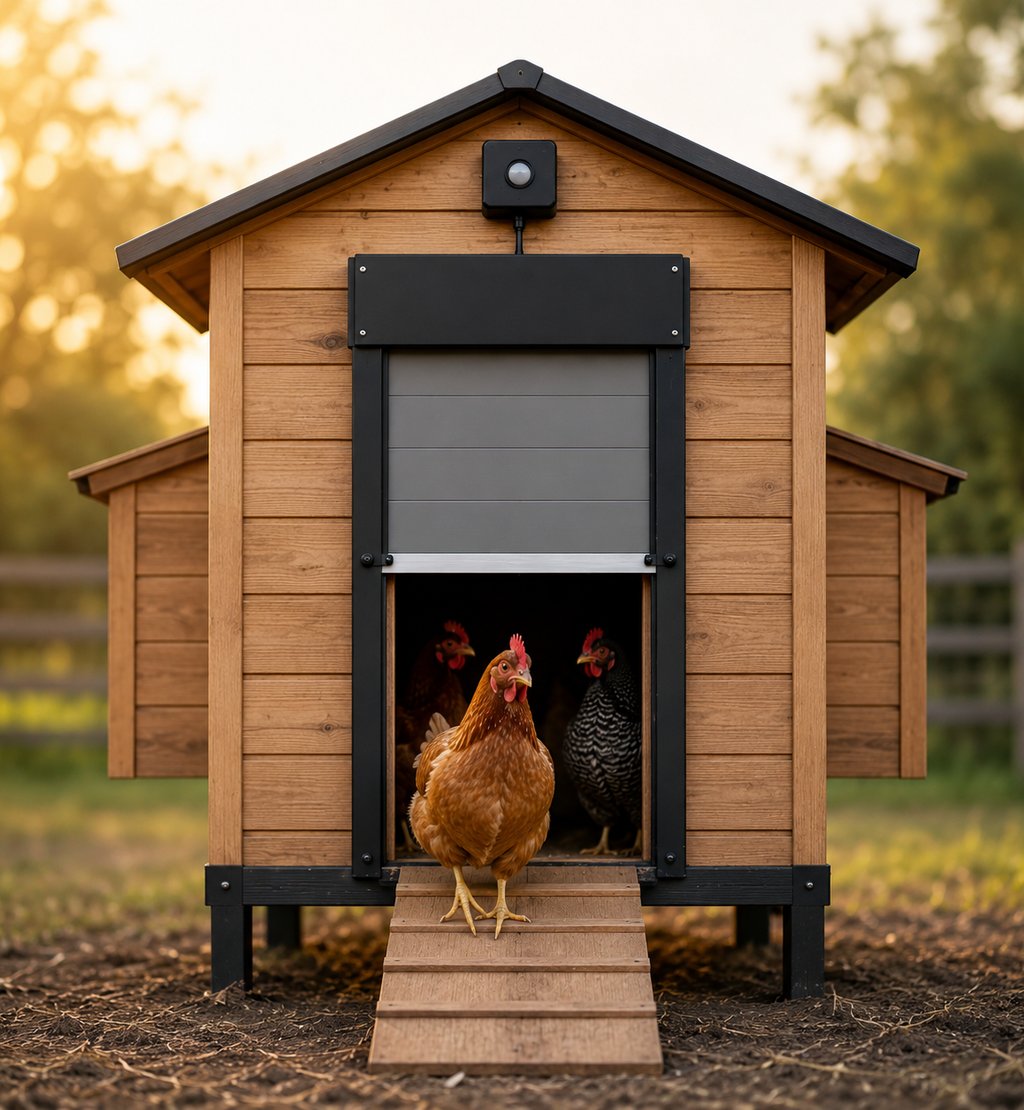
Smart Automated Chicken Coop Doors: The Complete Predator Protection Guide
Every backyard flock owner learns the same hard lesson eventually: a single forgotten latch is all a predator needs. A smart automated chicken coop door eliminates that risk entirely — closing and deadbolting the coop at dusk without any human input, every single night, whether you're home or not.
This guide covers how automated coop systems work, what separates a reliable deadbolt system from a basic motorized slider, and how to choose the right setup for your flock, property, and budget.
Why Predator Attacks Are So Costly — and So Preventable
Predator losses aren't just emotionally devastating — they're expensive. According to the USDA National Agricultural Statistics Service, backyard poultry owners report predation as the leading cause of flock loss, with foxes, raccoons, and hawks responsible for the majority of incidents. A mature laying hen represents months of feed investment; a breeding rooster can be worth several hundred dollars. One successful nighttime break-in can wipe out an entire flock in under 20 minutes.
The most common predators homesteaders face include:
Raccoons — highly dexterous, capable of opening standard hook latches and prying soft mesh
Foxes — persistent diggers that test perimeter gaps repeatedly
Coyotes — strong enough to breach lightweight fencing
Hawks and owls — daytime and nighttime aerial threats
Stray dogs — often the most destructive in suburban and semi-rural areas
The frustrating reality is that most successful predator attacks exploit human error — a door left open after an evening distraction, a latch improperly secured, or a gate left ajar after collecting eggs. Automation doesn't just add hardware security; it removes the human variable entirely.
The Problem With Traditional Coop Security
Standard coops typically rely on hook latches, slide bolts, and manual doors. These work — until they don't.
Raccoons are the most well-documented latch manipulators. Research from wildlife behavior studies shows raccoons can solve multi-step puzzle mechanisms, and a simple hook-and-eye latch is well within their capability. They have near-human finger dexterity and will spend hours testing a weak point on a coop perimeter.
Thin chicken wire compounds the problem. Hardware cloth (welded wire with ½-inch openings) is the correct material for predator exclusion — but many coops ship with lightweight hexagonal wire that coyotes, foxes, and even large raccoons can tear or bite through.
Manual doors introduce a third vulnerability: the human schedule. Evening commitments, illness, travel, and simple forgetting all create exposure windows. A single missed lockup is all it takes.
How a Smart Automated Chicken Coop Door Works
A smart automated coop door replaces the manual close-and-latch routine with a motorized, sensor-driven system. Here's how the main components work together:
Light Sensor vs. Timer Control
Most quality automated doors offer both options. Ambient light sensors detect the natural light threshold at dusk and dawn, automatically triggering open and close cycles in sync with the flock's biological rhythm. Programmable timers give owners precise schedule control regardless of seasonal light changes — useful in northern climates where daylight shifts dramatically between summer and winter.
High-end systems like the Omlet Automatic Chicken Coop Door allow both modes simultaneously, with an override app for manual control.
Electronic Deadbolt Locking Mechanisms
This is the critical distinction between budget sliders and premium systems. A basic motorized door slides up or down but relies on gravity or friction to stay closed — determined predators can still pry or lift it. Premium automated systems use mechanical deadbolt grooves and high-torque motors that physically lock the door panel into reinforced aluminum tracks once closed. The door cannot be lifted, pried, or scratched open from the outside.
The Run-Chicken automatic coop door is a good example of this design — the door panel locks into a grove system, and the motor holds tension on the mechanism even when unpowered.
Solar Power and Battery Backup
Many modern automated coop systems operate fully off-grid. A small integrated solar panel trickle-charges an internal battery throughout the day, providing enough energy to run the motor and electronics for weeks without direct sunlight. Most quality systems include a low-battery alert so owners receive a warning before any failure risk.
This matters especially for rural homesteaders who experience frequent power outages, or for coops located away from electrical infrastructure.
Remote Monitoring and Smartphone Control
Cloud-connected coop systems let owners check door status, receive open/close confirmation alerts, monitor battery level, and trigger manual overrides from anywhere with a cell signal. For homesteaders who travel, work long hours, or manage multiple structures, this real-time visibility is transformative.
Alert types typically include: door-failed-to-close warnings, low battery notifications, and scheduled open/close confirmation logs.
Automated Coop Door Comparison: Top Systems in 2026
Omlet Automatic Chicken Coop Door · $199.00 (approx.)
Premium automatic coop door with Wi‑Fi support, strong predator protection, and the best smart-home style controls.
The Omlet is basically the “set it and forget it” option. It’s the most polished system of the three and the only one with real app support through the Omlet Hub. That matters more than people think once you start traveling, getting home late, or wanting remote control during storms or freeze events.
What stands out:
Strong predator-resistant vertical door design
Excellent battery life (often close to a year)
Remote/app controls
Smooth seasonal light adjustment
Very beginner friendly installation
Downsides:
Highest price
App features require Omlet ecosystem add-ons
Slightly more tech-heavy than some homesteaders want
Best for:
Busy owners
Tech-forward setups
People who travel
Larger flocks where reliability matters most
The Wi-Fi-enabled smart features and dawn/dusk automation are confirmed on Omlet’s official product pages.
Best Budget-Friendly Choice
RUN-CHICKEN T50 Automatic Coop Door · $139.90 (approx.)
Affordable automatic coop door with reliable timer and light sensor controls and surprisingly strong durability for the price.
Run-Chicken built a reputation because the doors just work without much fuss. The T50 gives you the core features most backyard chicken owners actually need:
Timer
Light sensor
Weather resistance
Reliable auto open/close
The newer Bluetooth versions are a nice middle ground too, though not as advanced as Omlet’s full app ecosystem.
Where it shines:
Lower price
Simple setup
Good cold-weather reliability
Lightweight and efficient
Tradeoffs:
Fewer premium features
Less polished interface
Battery life varies more depending on winter temps
Best for:
Small backyard flocks
First-time chicken keepers
Budget-conscious buyers
Owners who want simple over “smart”
Best Mid-Range / Rugged Option
ChickenGuard Premium Automated Coop Door $216.00 (approx.)
Durable predator-resistant automatic coop door with flexible power options and strong locking security.
ChickenGuard sits in the middle between Omlet and Run-Chicken. It’s known for sturdy locking systems and flexibility with power sources, especially solar add-ons.
Big advantages:
Strong locking mechanism
Good predator resistance
Flexible timer + light sensor modes
Solar compatibility
Durable weatherproof housing
Weak points:
Interface feels older
Battery life is shorter than Omlet
Setup menus are less intuitive
Best for:
Rural predator-heavy areas
People wanting rugged over fancy
Mid-size coops
Owners comfortable tweaking settings
ChickenGuard models advertise multiple operating modes and predator-resistant locking systems across several current listings.
Prices reflect approximate retail as of May 2026. Verify current pricing on manufacturer websites before purchasing.
Escaped Livestock: The Other Risk Automation Solves
Predator protection gets most of the attention, but escaped livestock is an equally costly problem. A gate left open — even briefly — can send goats, pigs, free-range poultry, or sheep into vegetable gardens, irrigation systems, or neighboring properties. Crop damage from a single escaped livestock incident can easily run into the hundreds or thousands of dollars within hours.
Electronic livestock gates with programmable schedules and remote override capability address this problem the same way automated coop doors address predators: by removing human error from the equation. Learn more about electronic pet doors and containment options →
Choosing the Right Automated Coop System for Your Homestead
The right system depends on four variables:
1. Flock size and coop door dimensions. Measure your existing coop door opening before purchasing. Most automated doors fit standard openings up to 12–13 inches wide, but larger coops housing 20+ birds often have wider openings that require custom or commercial-grade solutions.
2. Power availability. If your coop is within reach of an extension cord, battery-powered systems still make sense but solar adapters become less critical. For remote coops more than 50 feet from power, prioritize a system with robust solar charging and low-battery alerts.
3. Your monitoring preferences. If you travel frequently or manage the coop remotely, an app-connected system like the Omlet is worth the price premium. For a coop you check daily on-site, a standalone timer-based unit like the Run-Chicken T50 is perfectly capable.
4. Budget. Entry-level systems start around $80–100 but often lack deadbolt mechanisms. For meaningful predator protection, budget $150–$220 for a quality unit with groove-locking hardware. Consider it a one-time insurance payment against flock replacement costs.
For a hands-on breakdown of how one of these systems holds up in real homestead conditions, read our full Smart Automated Chicken Coop Door review →
Common Homesteader Mistakes That Lead to Losses
Using thin chicken wire instead of hardware cloth. Hexagonal wire is not predator-proof. Replace perimeter mesh with welded ½-inch hardware cloth, buried 6–12 inches underground to prevent digging entry.
Skipping battery backup. Automation without reliable power redundancy creates a false sense of security. Always confirm your system includes battery backup and low-power alerts.
Relying on a single lock point. An automated door is one layer of defense. Combine it with padlock-style secondary latches on the exterior coop door, hardware cloth flooring or an apron skirt, and covered run roofing for full protection.
Neglecting the run perimeter. The coop door secures birds inside the coop structure — but a predator can still enter an unsecured outdoor run. Enclose the run with hardware cloth on all sides and the roof, and bury or skirt the perimeter.
Frequently Asked Questions
What is an automatic chicken coop door?
An automatic chicken coop door is a motorized door system that opens and closes on a programmed schedule or light-sensor trigger, securing the coop from predators without manual intervention. Premium models include electronic deadbolt mechanisms that physically lock the door panel closed.
Are automated coop doors predator-proof?
High-quality systems with groove-track deadbolts and reinforced aluminum frames offer significantly stronger predator resistance than standard slide bolts or hook latches. No system is unconditionally predator-proof, but quality automated doors eliminate the most common entry vector: human error in the nightly lockup routine.
Do automated chicken coop doors work during power outages?
Most quality systems run on AA batteries or rechargeable battery packs with optional solar charging, making them independent of grid power. Systems with solar panels and backup battery banks can operate indefinitely off-grid.
Can raccoons open normal coop latches?
Yes. Raccoons have near-human dexterity and documented problem-solving ability. Standard hook-and-eye latches and simple slide bolts are within their capability to manipulate. Automated deadbolt systems that lock mechanically from the inside are significantly harder to defeat.
How much do automated coop doors cost?
Entry-level motorized doors start around $80–100, but lack mechanical locking. Quality predator-resistant systems with deadbolt hardware typically run $149–$220. App-connected premium models (like the Omlet with Hub) sit at the top of that range.
Are smart coop systems worth it for small flocks?
For any flock with genuine investment value — egg-laying hens, breeding stock, or heritage breeds — the answer is yes. Preventing even one predator attack typically recoups the system cost. For a casual backyard setup with 2–3 pet hens, a simpler manual latch with hardware cloth may suffice.
Final Thoughts
A smart automated chicken coop door is the most reliable single upgrade available for backyard flock protection. It removes human error, adds deadbolt-level security, runs independently of grid power, and delivers remote monitoring for off-site peace of mind. Combined with hardware cloth perimeter reinforcement and a covered run, it creates a layered predator defense that holds up against raccoons, foxes, coyotes, and aerial predators alike.
For homesteaders serious about protecting their flock investment, automation isn't a luxury — it's a standard operating procedure.
→ Read our hands-on Smart Automated Chicken Coop Door review → Explore all Small Pet & Homestead Tech → → GPS and tracking options for outdoor livestock monitoring →
Affiliate disclosure: Pet Ecosystems participates in affiliate marketing programs. We may earn commissions from qualifying purchases at no additional cost to you. Our recommendations are based on independent research and product testing.
Affiliate Disclosure:
Pet Ecosystems participates in affiliate marketing programs, which means we may earn commissions from qualifying purchases made through links on this website at no additional cost to you.
Our recommendations are based on independent research, product reviews, and editorial opinions intended to help pet owners discover quality products and smart solutions for their pets.
© 2026 Pet Ecosystems. All rights reserved.
Contacts
info@petecosystems.com