Smart Reef Lighting Wavemaker Guide for Corals
Discover how smart reef lighting wavemaker systems can help maintain ideal PAR levels and water flow for healthier corals and stable reef aquariums. Explore the science, top systems, and setup tips for optimal results.
AQUATICAQUARIUM LIGHTING/ EQUIPMENT
Joe Morgan Pet Ecosystems Team
5/28/202610 min read
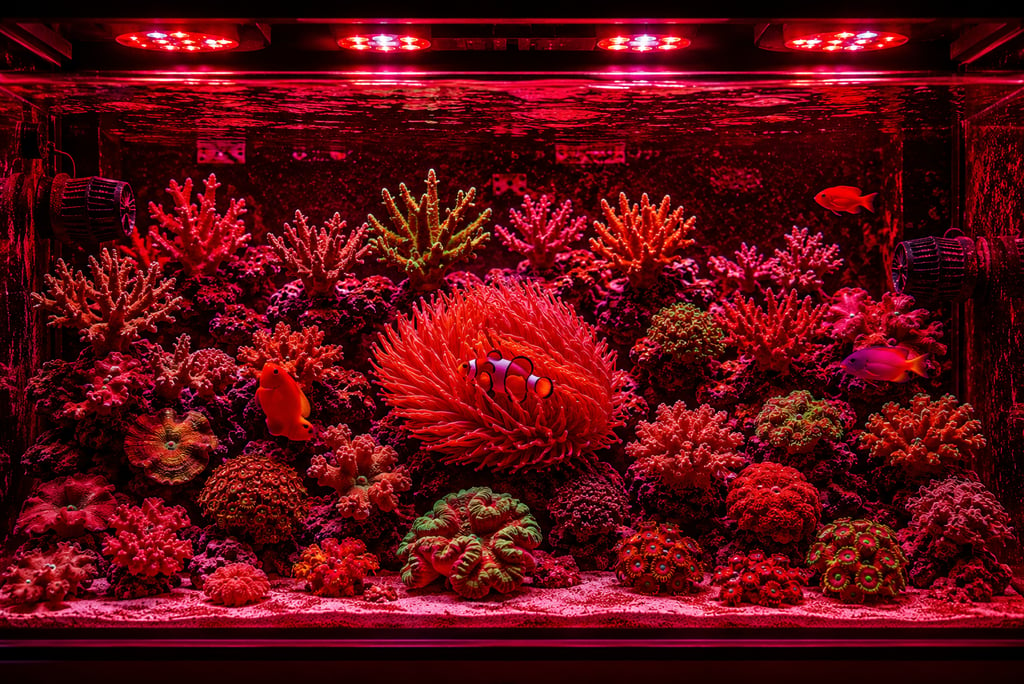
Smart Reef Lighting and Wavemakers: PAR, Flow, and Coral Health Explained (2026)
Two variables determine whether corals in a reef aquarium thrive or slowly decline: light quality and water movement. Get both right and even sensitive SPS corals grow steadily and display vivid fluorescent coloration. Get either one wrong and you'll spend months troubleshooting browning, recession, and tissue loss that traces back to a fixable equipment choice.
This guide explains the science behind reef lighting and flow — what PAR actually means in practice, why wavemakers matter more than powerheads, what the leading smart systems do that basic equipment can't, and how to dial in both variables for your specific tank and coral mix.
The Biology Behind the Equipment: Why Corals Are Different From Fish
Understanding why reef lighting and flow matter requires understanding how corals feed.
Most corals are mixotrophic — they feed through two simultaneous mechanisms. They capture zooplankton and suspended particles from the water column through their tentacles (heterotrophic feeding). And they rely on zooxanthellae — symbiotic photosynthetic algae living inside their tissue — to produce sugars through photosynthesis (autotrophic feeding).
In most healthy reef corals, zooxanthellae provide 70–90% of their host's energy. This means light isn't supplementary for corals — it's their primary food source. A coral in inadequate light is essentially in a slow state of starvation, even if the water chemistry is perfect.
This dependency creates two practical requirements:
The right light spectrum — zooxanthellae use specific wavelengths, particularly blue (420–490nm) and red (620–700nm), most efficiently. Broad-spectrum white light that looks bright to human eyes may deliver almost no usable energy to coral photosynthetic pathways.
The right light intensity — measured as PAR (Photosynthetically Active Radiation) in μmol/m²/s. Too low and corals can't photosynthesize adequately. Too high and they expel their zooxanthellae in a stress response — the bleaching event visible as a coral turning white.
Water flow addresses a completely separate but equally critical need: corals are sessile organisms. They cannot move away from waste accumulating against their tissue, and they cannot swim toward suspended food particles. Water movement does both jobs — continuously flushing waste off coral surfaces and delivering nutrients to their feeding polyps.
PAR Demystified: What the Numbers Actually Mean
PAR (Photosynthetically Active Radiation) measures light in the 400–700nm wavelength range in micromoles of photons per square meter per second (μmol/m²/s). In a reef context, you'll also see the related metric PUR (Photosynthetically Usable Radiation) — a more refined measure that weights only the wavelengths zooxanthellae actually use.
PAR target ranges by coral type:
Low-Light LPS Corals: 50–150 PAR (μmol/m²/s)
Best for corals like Hammer, Torch, Frogspawn, and Elegance corals
Too much light may cause bleaching or tissue recession
Mid-Light LPS & Soft Corals: 150–250 PAR
Ideal for Candy Cane corals, Brain corals, and Zoanthids
Provides balanced growth and coloration without excessive stress
High-Light SPS Corals: 250–450 PAR
Suitable for Acropora, Montipora, and Stylophora species
Stable lighting is critical for coloration and calcification
Ultra-High-Light SPS (Upper Reef Zone): 400–600+ PAR
Designed for wild-collected Acropora and large tabling corals
Excessive instability at these levels can rapidly bleach sensitive SPS corals
These ranges explain why coral placement in the tank matters as much as light intensity setting. A single fixture set to 60% intensity might deliver 400+ PAR at the top of the aquascape (10 inches below the water surface) and only 80 PAR at the sand bed. Placing a hammer coral at mid-tank and an Acropora colony at the top of the rockwork is not just aesthetic preference — it's putting each coral in its functional PAR zone.
PAR measurement: A PAR meter (Apogee MQ-510 is the reef hobby standard at ~$270) is the only way to actually know what your corals are receiving. Manufacturer intensity percentages are meaningless without knowing the delivered PAR at depth — a fixture's 50% intensity on a 24-inch deep tank delivers very different PAR than the same 50% on a 16-inch shallow aquascape.
Smart Reef LED Lighting: What Separates Premium Systems
The shift from metal halide and T5 fluorescent to LED has been complete for nearly a decade in the reef hobby. What's happened since then is a rapid expansion in the sophistication of LED control — and a widening gap between entry-level and premium systems.
What makes a reef LED "smart":
Multi-channel independent control. Premium fixtures have 8–12 independently controllable LED channels — deep blue (420nm), royal blue (450nm), blue-white (470nm), neutral white (6500K), cool white (14000K–20000K), violet (410nm), UV (395nm), and sometimes red/green channels for specific applications. This granular control lets you dial in the exact spectrum output for your coral mix, not just "blue" versus "white."
Programmable 24-hour schedules. Sunrise simulation (gradual ramp-up over 60–90 minutes), peak intensity window, afternoon cloud cover dimming, sunset ramp-down, and moonlight phase — all configurable to run automatically. This matters because abrupt lighting transitions stress corals; gradual simulated natural cycles allow normal daily biological rhythms.
Acclimation mode. When introducing new corals — especially SPS frags from a lower-PAR system — sudden full-intensity exposure causes bleaching. Premium fixtures have built-in acclimation schedules that start at reduced intensity and gradually step up over 2–4 weeks to full programmed output, protecting new additions during their adjustment period.
App and ecosystem integration. WiFi-connected fixtures integrate with reef controller platforms (Neptune Apex, GHL ProfiLux, CoralVue Hydros) for synchronized control across all tank systems. A single automation script can trigger "storm mode" (rapid intensity fluctuations simulating cloud cover) simultaneously across the lighting, wavemakers, and dosing systems.
EcoTech Radion XR30 G6 Blue — The Reference Standard
Best for: SPS-dominant and mixed reefs, 24–48" tank length per fixture PAR output: Up to 1,000+ μmol/m²/s at 12" depth Spectrum: 10-channel LED array including UV, violet, deep blue, blue, cyan, green, red, warm white, cool white Control: EcoSmart Live app + ReefLink hub Price range: $750–$850
The Radion XR30 G6 Blue has been the benchmark premium reef fixture for the better part of a decade, and the G6 generation maintains that position. The Blue variant prioritizes the deep blue and violet channels that SPS corals respond to most dramatically — both in growth rate and fluorescent coloration. The 10-channel control through EcoSmart Live is mature, stable, and deeply integrated with the wider EcoTech ecosystem.
Its primary competition is the AI Hydra 64 HD ($550–$650) and the Kessil A360X ($600–$700) — both strong performers at lower price points. The Radion earns its premium through superior app stability, the ReefLink hub's offline scheduling capability, and its integration with EcoTech's Vortech wavemaker ecosystem for full synchronized control.
AquaIllumination (AI) Prime 16HD — Best Value for Mid-Size Tanks
Best for: Nano to mid-size reefs, 12–24" tank footprint PAR output: Up to 400+ μmol/m²/s at center Spectrum: 7-channel LED Control: myAI app Price range: $230–$280
The Prime 16HD is the most widely used reef LED in the hobby by volume, and for good reason. At under $280, it delivers genuine SPS-capable PAR output, 7-channel control, and a mature app ecosystem. For tanks up to 24" wide, one or two Primes cover the tank adequately. For 36"+ tanks, the AI Hydra 64 HD is the step up.
Wavemakers vs. Basic Powerheads: What the Difference Means for Corals
A standard aquarium powerhead creates a fixed unidirectional flow stream. Point it across the tank and it moves water in one direction at one constant speed — the same stream, the same direction, 24 hours a day.
The problem: corals adapted to that flow pattern extend their tissue downstream over time. The upstream face of the coral and any colonies in the flow shadow receive almost no water movement. Waste accumulates in these dead zones. Oxygen levels drop. Detritus settles into crevices in the rockwork and becomes a nutrient export failure point.
Natural reef environments don't work this way. Ocean reef flow is constantly varying in speed and direction — surge, backwash, tidal current shifts, and wave action create a chaotic three-dimensional flow pattern that simultaneously reaches every surface of every coral.
Smart wavemakers replicate this variability through several mechanisms:
Pulse and surge modes: The pump alternates between full power and reduced power at set intervals — creating push-and-pull water movement that rocks coral polyps back and forth rather than pinning them in one direction.
Random flow mode: Randomized timing and intensity variation that prevents any single flow pattern from becoming predictable. This is the mode most closely approximating natural reef conditions.
Night mode: Reduced flow during the overnight period when corals extend feeding tentacles — high flow during tentacle extension physically prevents effective zooplankton capture.
Wireless synchronization: Multiple wavemakers positioned at opposite ends of the tank communicate wirelessly to create alternating surge patterns — one pump fires while the other rests, creating a side-to-side water movement cycle that covers the full tank volume.
EcoTech Marine Vortech MP40 — Best for Mid to Large Reefs
Best for: 75–200+ gallon reefs, 20–26" tank width Flow rate: Up to 4,000 GPH Control: EcoSmart Live app (shared with Radion) Mounting: External motor with internal magnet impeller — motor stays dry outside the tank Price range: $350–$400
The Vortech's external motor design is its most practical advantage — the motor never contacts saltwater, eliminating the corrosion and impeller fouling that eventually affects all submerged pumps. The wet-side impeller magnetically couples through the tank glass. Combined with EcoSmart Live integration, Radion and Vortech units run on synchronized schedules — lighting storm simulations trigger matching surge increases automatically.
AI Nero 5 — Best Value Wavemaker
Best for: 75–150 gallon reefs Flow rate: Up to 2,100 GPH (adjustable) Control: myAI app (shared with AI lighting) Mounting: Submerged Price range: $130–$160
The Nero 5 is the most accessible performance wavemaker in the hobby. At $130–$160, it delivers the pulse, surge, and random flow modes that matter for coral health, integrates with the myAI app for scheduling and control, and runs reliably in submerged operation. For reefers running AI lighting, the shared app ecosystem is a practical convenience. Not the EcoTech build quality, but highly capable for the price.
Synchronizing Light and Flow: The Ecosystem Approach
The most significant advance in recent reef automation isn't any single product — it's the ability to synchronize light and flow as a unified ecosystem rather than two separate systems running independently.
A practical synchronized schedule for a mixed reef:
6:00–8:00 AM
Light Intensity: Sunrise ramp from 0–30%
Flow Mode: Low pulse / night mode
Helps fish and corals transition gradually into daytime conditions
8:00–11:00 AM
Light Intensity: Ramp from 30–70%
Flow Mode: Moderate random flow
Encourages coral polyp extension and active photosynthesis
11:00 AM–2:00 PM
Light Intensity: Peak output at 70–85%
Flow Mode: Full random / surge mode
Simulates peak tropical reef sunlight and strong daytime currents
2:00–3:00 PM
Light Intensity: Simulated cloud cover at 60–70% variable output
Flow Mode: Surge burst mode
Creates a more natural reef lighting pattern and prevents overstressing corals
3:00–6:00 PM
Light Intensity: Gradual decline from 70–50%
Flow Mode: Moderate random flow
Maintains coral feeding response while easing toward evening conditions
6:00–8:00 PM
Light Intensity: Sunset ramp down from 50–5%
Flow Mode: Gentle pulse mode
Supports smoother fish behavior and reduced coral stress before night cycle
8:00 PM–6:00 AM
Light Intensity: Moonlight mode at 1–3%
Flow Mode: Reduced night mode flow
Mimics nighttime reef conditions and allows fish and corals to rest
Running both systems on a coordinated schedule means the tank's biological environment shifts in sync — light availability and nutrient delivery increase together during peak photosynthesis hours, then taper together as corals transition to heterotrophic night feeding.
How to Dial In Lighting for a New Reef Tank
Start at 40–50% intensity and ramp up over 4–6 weeks. Even if your corals came from a high-PAR system, your tank's water column, depth, and glass transmission are different. Starting lower and ramping up protects against light shock and gives corals time to adjust their zooxanthellae density.
Use a PAR meter before making permanent placement decisions. Map PAR at 4–6 points across your aquascape at your intended final intensity. This takes one hour and will prevent months of guessing why corals in a particular spot aren't growing.
Prioritize spectrum over intensity for color. Blue and violet channel intensity drives coral fluorescent coloration more than total PAR. If your corals are browning (losing zooxanthellae) despite adequate PAR, increase the blue/violet ratio before increasing overall intensity.
Don't run maximum intensity. Most reef LED fixtures at 100% output deliver more PAR than any coral in the tank needs and generate unnecessary heat. Most successful reef keepers run premium fixtures at 60–80% peak intensity.
Frequently Asked Questions
What is PAR and why does it matter for reef corals? PAR (Photosynthetically Active Radiation) measures the light energy available for photosynthesis in the 400–700nm wavelength range, expressed in μmol/m²/s. Corals depend on their symbiotic zooxanthellae algae for 70–90% of their energy, and zooxanthellae require adequate PAR to photosynthesize effectively. Insufficient PAR leads to slow starvation; excessive PAR triggers bleaching.
Why do reef lights emphasize blue spectrum? Blue and violet wavelengths (420–490nm) penetrate water more effectively than red wavelengths, which are absorbed rapidly at depth. In natural reef environments, corals primarily receive blue-dominant light at depth. Blue spectrum also drives coral fluorescent protein expression, producing the vivid coloration that distinguishes healthy SPS specimens.
What flow rate do I need for a reef tank? As a baseline, aim for 20–40x total tank volume per hour in combined flow across all pumps. A 100-gallon reef benefits from 2,000–4,000 GPH total circulation. More important than the number is the distribution — randomized, multidirectional flow that eliminates dead zones matters more than raw GPH from a single powerhead.
Are wavemakers necessary or can I use regular powerheads? Regular powerheads are adequate for fish-only saltwater tanks and some hardy LPS setups. For SPS corals and mixed reefs, wavemakers with pulse, surge, and random flow modes produce meaningfully better coral health outcomes — better tissue extension, reduced detritus accumulation, and lower incidence of tissue infection in flow-shadow zones.
Can I use smart reef lighting on a freshwater planted tank? Yes, with caveats. Premium reef LEDs have strong blue channels optimized for coral photosynthesis spectra. Freshwater plants use a broader spectrum more balanced toward red (640–680nm). Reef lights work on planted tanks but may not deliver the optimal spectrum for maximum plant growth. Dedicated planted tank LEDs (Fluval Plant 3.0, Finnex Planted+) are better value for that application.
What's the difference between the EcoTech Radion and the AI Hydra? Both are premium multi-channel reef LEDs capable of SPS-level PAR output. The Radion G6 has stronger build quality, a more mature and stable app, and native integration with EcoTech's Vortech wavemaker ecosystem. The AI Hydra 64 HD is $150–$200 less expensive, also performs at SPS capability, and shares an app ecosystem with AI's Nero wavemakers. For existing EcoTech users, the Radion is the obvious choice. For value-focused buyers building a new system, the Hydra is compelling.
Final Thoughts
Reef corals are not passive decorations — they're living organisms with precise environmental requirements evolved over millions of years on tropical ocean reefs. Getting the light spectrum, PAR intensity, and water movement right isn't overengineering a fish tank; it's meeting the biological needs of the animals in your care.
Smart reef LED systems and programmable wavemakers don't just make this easier — they make it achievable consistently, day after day, without manual intervention. The combination of graduated daily light cycles, randomized flow patterns, coral acclimation modes, and synchronized ecosystem automation represents a genuinely meaningful advance in what's possible for home reef keeping.
For reefers serious about long-term coral health and growth, this is the equipment tier that makes the difference.
Affiliate disclosure: Pet Ecosystems participates in affiliate marketing programs. We may earn commissions from qualifying purchases made through links on this site at no additional cost to you. Our recommendations are based on independent research and editorial review.
Affiliate Disclosure:
Pet Ecosystems participates in affiliate marketing programs, which means we may earn commissions from qualifying purchases made through links on this website at no additional cost to you.
Our recommendations are based on independent research, product reviews, and editorial opinions intended to help pet owners discover quality products and smart solutions for their pets.
© 2026 Pet Ecosystems. All rights reserved.
Contacts
info@petecosystems.com