Satellite GPS Dog Fence: Virtual Borders for Large Properties
Skip the $10K fence bill. Smart GPS solar containment collars use satellite tech & neuro-behavioral conditioning to secure large acreage — here's how the satellite GPS dog fence works.
DOG
Eli Flores Pet Ecosystem Team
6/2/20268 min read
Satellite GPS Dog Fence: The Science Behind Virtual Borders for Large Properties
If you manage a large property — a multi-acre homestead, a rural acreage, or even a large suburban lot — animal containment is one of the most expensive and persistent headaches you deal with.
Traditional physical fencing on large properties is not just inconvenient. It is genuinely cost-prohibitive. Clearing brush, digging post holes, installing posts, and running timber or vinyl panels across hundreds or thousands of linear feet easily runs $5,000 to $15,000 or more depending on property size and terrain. And that investment requires ongoing maintenance — rot, storm damage, digging dogs, and chew-happy breeds mean physical fences have a lifespan, not a permanent fix.
That is why advanced pet owners and rural homesteaders are making the switch to smart GPS solar containment systems — satellite-based virtual fencing technology that creates an invisible, adjustable boundary line anywhere on your property without a single post hole.
This guide breaks down exactly how the aerospace technology behind these systems works, why the behavioral conditioning approach is fundamentally different from old shock fence systems, and who genuinely benefits from the investment.
Already researching specific models? Read our GPS Dog Fence vs Traditional Fence Guide → for a full cost and safety comparison.
Why Physical Fencing Fails Large Properties
Before getting into the technology, it is worth understanding exactly why traditional containment methods break down at scale.
Cost scales with perimeter, not with area. A 5-acre property might need 1,800+ linear feet of fencing. At $8–$12 per linear foot installed, that is $14,000–$21,000 before permits, grading, or gate hardware.
Terrain creates gaps. Rolling hills, creek beds, dense tree lines, and uneven ground make continuous fence installation physically difficult and structurally unreliable. Active dogs find the lowest point every time.
Maintenance never stops. Wood rots. Vinyl warps in extreme temperatures. Metal chain-link rusts. Posts shift in freeze-thaw cycles. A large physical perimeter requires constant inspection and repair investment year after year.
Fixed boundaries cannot be adjusted. If you add a structure, expand a garden, or want to restrict your dog from a specific zone on the property, a physical fence requires physical modification — labor, materials, time.
Smart GPS containment systems solve every one of these problems simultaneously.
The Physics Behind Multi-GNSS Real-Time Tracking
The core technology that makes modern virtual fencing possible is multi-GNSS positioning — and understanding how it works explains why it is fundamentally more reliable than the wireless radio-based fence systems of a decade ago.
How Old Wireless Systems Failed
First-generation wireless fences worked by placing a transmitter base station in the home that broadcast a short-range radio bubble outward from the house. The dog's collar detected the boundary of that radio signal and triggered a correction when breached.
The problem: radio signals are easily disrupted. Metal outbuildings, dense tree canopy, rolling terrain, and even heavy rain could cause the signal to block or deform — meaning the boundary line was inconsistent. Dogs learned the gaps. Worse, collar malfunctions caused corrections inside the safe zone — creating anxiety and confusion.
How Satellite GPS Positioning Works Differently
Modern premium containment collars bypass ground-based signal problems entirely by connecting directly to orbital satellite networks.
The collar contains an internal microprocessor that simultaneously locks onto multiple Global Navigation Satellite Systems (GNSS) — including GPS (United States), GLONASS (Russia), Galileo (European Union), and BeiDou (China). By cross-referencing position data from multiple independent satellite arrays at high orbital altitude, the collar calculates the dog's exact geographic coordinates on the planet in real time.
This positioning is:
Independent of any home base station — no Wi-Fi, no radio transmitter, no central hub required
Terrain-agnostic — satellite signals reach the collar regardless of hills, trees, or metal structures between the collar and the house
Accurate to within a few meters — sufficient to establish and enforce a reliable boundary line
The boundary itself is defined digitally — you draw it on a map in the companion app. The collar knows exactly where the dog is relative to that line at all times, triggering the warning and correction sequence based on real GPS position rather than signal proximity.
Solar Harvest Engineering: Solving the Battery Problem
One of the most significant practical limitations of GPS tracking collars — and the reason many large-property owners have hesitated to adopt them — is battery life.
On a 200-acre ranch, a dog that escapes and whose collar battery dies creates a genuine emergency. You have no location data, no active boundary, and no way to track the animal remotely.
Premium containment systems address this through integrated solar harvest engineering.
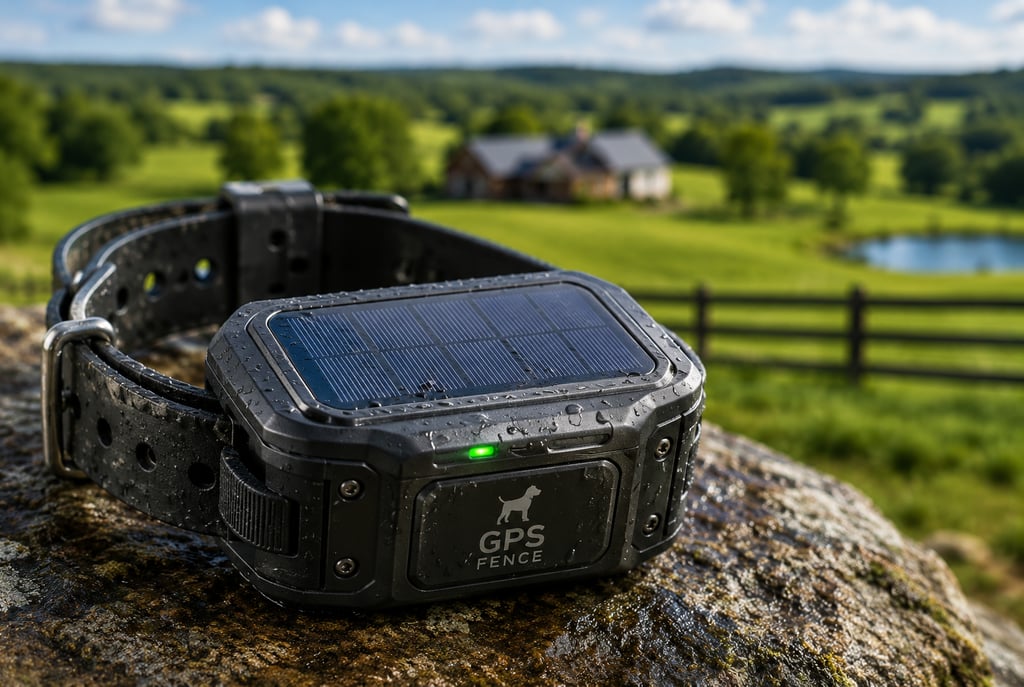
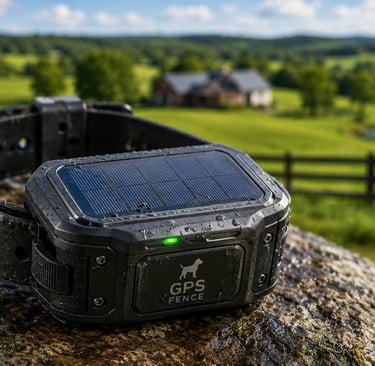
The exterior casing of high-tier GPS collars is lined with a ruggedized solar panel matrix designed for outdoor durability — rated to withstand dense brush contact, heavy mud submersion, and sub-zero winter temperatures. This solar array operates on ambient daylight, not direct sunlight — meaning it charges even on overcast days, in shaded tree cover, and during winter months when sun angles are low.
The solar harvest feeds directly into the collar's high-capacity internal battery, creating a continuous off-grid power cycle. In practical terms this means:
No daily charging routine — the collar powers itself through normal outdoor activity
No battery depletion risk during extended time outdoors
Boundary stays active 365 days a year without manual intervention
For large-property owners who cannot realistically bring their dog inside every night for a charge, solar autonomy is not a premium feature — it is a fundamental requirement.
Neuro-Behavioral Conditioning vs. Random Shock
This is where modern GPS containment systems have made the most significant advancement over their predecessors — and where the biggest misconception about "shock fences" needs to be corrected directly.
Old containment systems operated on a binary logic: dog crosses the line, dog receives a static correction. The correction was the entire system. There was no warning, no escalation, no communication — just an unpredictable pain response that dogs associated inconsistently with the boundary.
The behavioral result was often chronic anxiety, fear of the yard itself, and in some cases aggression. The system worked through fear, not understanding.
Modern smart GPS collars use a three-stage neuro-behavioral conditioning sequence built on clear communication.
Stage 1 — The Warning Zone
As the dog approaches the boundary, the collar emits a high-pitched acoustic tone. This sound becomes the trained signal — through repetition, the dog learns that this specific tone means "boundary approaching, turn back." Most well-trained dogs respond to Stage 1 alone after a 2–3 week conditioning period.
Stage 2 — The Guidance Zone
If the dog continues moving toward the boundary, the collar delivers a firm vibration pattern — not a correction, but a physical sensation similar to a leash tug. This reinforces the audio signal with a tactile cue, mimicking the communication pattern dogs already understand from leash training.
Stage 3 — The Correction Zone
Only if the dog fully ignores both the audio tone and the vibration — actively pushing through both signals — does a controlled static correction activate. The stimulus level is adjustable and is calibrated to interrupt forward momentum, not to punish.
The critical difference from old systems: dogs are being taught a language, not conditioned through pain. After proper training, the vast majority of dogs respond to the Stage 1 tone before Stage 2 or Stage 3 ever activates. The boundary becomes a communication line, not a shock perimeter.
Who Actually Benefits From Satellite GPS Containment
🐕 Who Actually Benefits From Satellite GPS Containment?
Not every dog owner needs a GPS solar containment system. The truth is that these advanced collars provide the greatest value in specific situations where traditional fencing becomes expensive, impractical, or impossible.
🌾 Property Over 1 Acre
✅ Very High Value
Physical fencing across multiple acres can cost thousands of dollars in materials and labor. GPS containment offers a much more affordable solution for large properties.
🚜 Rural Properties & Working Homesteads
✅ Very High Value
Large farms, ranches, and homesteads often have uneven terrain, open fields, and multiple zones that make traditional fencing difficult. GPS boundaries provide flexible containment without permanent structures.
🏠 Renting or Unable to Install Permanent Fences
✅ High Value
Since no digging, trenching, or construction is required, GPS systems are ideal for renters or property owners who cannot make permanent modifications.
📋 HOA Restrictions on Physical Fencing
✅ High Value
Many neighborhoods restrict fence height, style, or installation altogether. Virtual boundaries provide containment without creating visible structures that violate HOA rules.
✈️ Frequent Travelers & Outdoor Adventures
✅ High Value
Portable GPS containment systems allow you to create temporary boundaries almost anywhere with satellite coverage, making them excellent for camping, RV travel, cabins, and vacation properties.
🏘️ Small Urban Backyards Under 0.25 Acres
⚠️ Low Value
For smaller suburban lots, a traditional fence or standard wireless dog fence is often more practical and cost-effective.
🐾 High-Drive Escape Artist Dogs
⚠️ Moderate Value
GPS containment can help reinforce boundaries, but dogs with a history of ignoring limits may still benefit from a physical fence combined with GPS tracking for maximum safety.
What to Look for in a Smart GPS Solar Containment Collar
Multi-constellation GNSS — the collar should lock onto at least GPS + GLONASS simultaneously. Four-constellation systems (adding Galileo and BeiDou) provide better accuracy in heavy tree cover and complex terrain.
Solar panel durability rating — look for IP67 or IP68 waterproofing and impact resistance ratings. A solar collar that cannot handle mud, rain, and brush contact is not rated for real-world large-property use.
Boundary accuracy specification — most quality GPS collars maintain 3–9 meter boundary accuracy under open sky. Understand that dense tree canopy or canyon terrain can reduce this to 10–20 meters. Match accuracy expectations to your specific terrain type.
Training program quality — the collar is only as effective as the training protocol behind it. Manufacturers that provide structured 2–3 week onboarding programs with escalation protocols produce significantly better behavioral outcomes than systems that ship with minimal training guidance.
App reliability and remote monitoring — real-time location tracking, boundary breach alerts, and battery/solar status should all be accessible remotely. Test app store reviews specifically for connectivity stability before committing.
Frequently Asked Questions
How accurate is satellite GPS fencing on large properties? Under open sky, quality multi-GNSS collars maintain boundary accuracy within 3–9 meters. In areas with dense tree canopy, the effective accuracy range widens to 10–20 meters. For most large-property applications, this precision is more than sufficient to establish reliable containment zones well away from roads or hazardous areas.
Does GPS fencing work without cell service? The GPS positioning itself relies on satellite signals and functions without cellular service. However, real-time tracking updates, live location monitoring through the app, and push notifications for boundary breaches typically require cellular connectivity. Verify the specific model's offline functionality before purchasing for remote rural use.
How long does training take for GPS virtual fencing? Most manufacturers recommend a 2–3 week structured introduction period. Week one focuses on introducing the boundary flags visually while the collar operates in audio-only mode. Weeks two and three gradually introduce the vibration and correction stages. Dogs trained through a proper escalation protocol typically respond to Stage 1 audio alone after the full training period.
Can GPS containment work for multiple dogs on the same property? Yes. Most premium GPS systems support multiple collar registrations within the same app, with individual boundary and correction settings for each dog. This is particularly useful on homesteads with working dogs of different temperaments and training levels.
Is solar charging reliable in winter or cloudy climates? Quality solar collars are engineered to harvest from ambient daylight rather than direct sunlight, which means they continue charging in overcast conditions, under shade, and at low winter sun angles. Performance decreases in extended periods of complete darkness (indoor confinement or polar winter conditions) but remains effective across the vast majority of real-world use cases.
Final Thoughts
For large-property owners, satellite GPS containment technology represents a genuine structural upgrade over physical fencing — not just in cost, but in flexibility, accuracy, and long-term reliability. The multi-GNSS positioning eliminates the terrain and signal limitations that plagued first-generation wireless systems. Solar autonomy removes the battery maintenance burden that made GPS collars impractical for working dogs. And neuro-behavioral conditioning replaces unpredictable shock training with a clear, communicative boundary protocol that produces better behavioral outcomes with less stress.
If you are managing more than an acre, dealing with HOA restrictions, or simply staring down a $10,000+ fence quote, smart GPS solar containment is worth serious evaluation.
Ready to see how the leading satellite GPS fence system performs in a real-world test? Read our comprehensive hands-on Smart GPS Solar Containment Fence Review → — satellite accuracy, solar performance, training program, and who it is built for.
Related: GPS Dog Fence vs Traditional Fence · LTE-M vs Bluetooth Pet Tracker · Dog Guide
Affiliate Disclosure:
Pet Ecosystems participates in affiliate marketing programs, which means we may earn commissions from qualifying purchases made through links on this website at no additional cost to you.
Our recommendations are based on independent research, product reviews, and editorial opinions intended to help pet owners discover quality products and smart solutions for their pets.
© 2026 Pet Ecosystems. All rights reserved.
Contacts
info@petecosystems.com